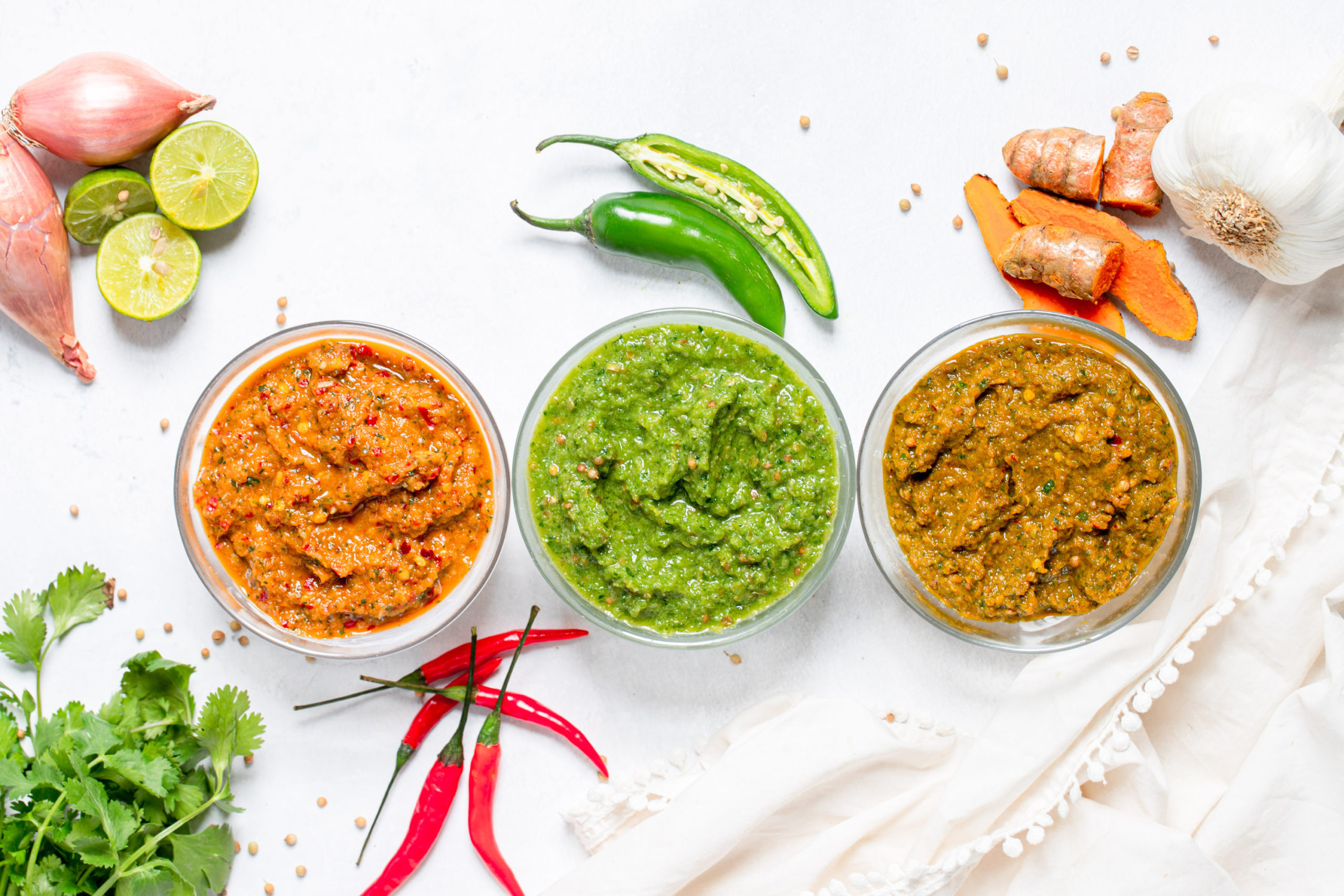
In Thai, sauces are widely considered the “grammar of the kitchen” because they connect, balance, and complete a dish; it complements, contrasts, or even offer completeness… the overall culinary experience is driven by this liquid element. However, the standards of dish complexity from this region is not achievable without a fulfilling foundational, enriching flavor paste to modulate tastes while leveraging the key flavor pillars of Thai cuisine; spicy, sour, sweet, and salty elements.

The Pre-Culinary Art: Pounding for Flavor Unification and Harmony
Before any Thai dish earns its place on a premium menu or in a high-standard kitchen, it begins with a decision that reputable brands quietly obsess over: how the flavor is engineered at its earliest stage. For brands that take authenticity seriously, pounding isn’t nostalgia—it’s strategy. The act of crushing lemongrass, galangal, chilies, and kaffir lime peel isn’t about muscle; it’s about coaxing essential oils out of the fibers in a way blades simply can’t.
And here’s why respected paste producers of thai curry paste still hold onto this principle; even when scaling:
- A refined aromatic release that preserves brightness and complexity
- A bespoke texture that interacts with fat more intelligently during blooming
- A pre-harmonized concentrate where herbal, spicy, and umami elements are balanced before heat is even applied
It’s the difference between a curry paste that performs—and one that merely participates.
The Architectural Blueprint: Defining the Signature Liquid Dish
In high-caliber Thai cooking, the paste is not an ingredient, it’s an architecture. Every premium curry you encounter began with decisions made at the level of composition and ratio, long before a chef stepped near a stove. Fresh green chilies create a character that is sharp, herbaceous, and almost luminescent. Dried red chilies produce warmth with a lingering, roasted softness. Indian-influenced spices shift the center of gravity entirely, creating a Massaman that feels slow, deep, and worldly.
What this means for restaurants and discerning cooks:
- Your paste predetermines your experience—flavor is not an accident
- Consistency becomes an asset, especially in professional kitchens
- Complexity becomes manageable, already engineered into the base
Premium dining is about intentionality. Thai curry pastes embody that by shaping the dish before the dish exists.
The Activation Threshold: Blooming the Paste in Fat
At the high end of Thai cuisine, the moment of blooming is treated as a transformation, not a step. When the paste is introduced to oil or thick coconut cream, it’s not simply coated; it is awakened. Raw aromatics surrender their edge, spices expand into their full aromatic spectrum, and the fat becomes a carrier with purpose, not merely a medium.
This stage elevates the entire dish through:
- Chromatic richness, as pigments move from paste to oil
- Even flavor distribution, ensuring no part of the final broth feels thin
- A foundational aroma, one that signals depth before the first taste
Blooming is where potential becomes performance. In a premium kitchen, overlooking this step is the fastest way to turn an extraordinary concentrate into a muted result. But not all sauces are the same; get a spice whose fat-soluble flavors are not flat.
The Flavor Amplifier: Finished Concentrates as Condiments
Then there is the other side of concentrated Thai flavor, the finished chili sauces like premium Sriracha. These aren’t cooking bases; they’re personalizers. If you’re serving guests, running a noodle bar, or simply eating with intention, this matters. These sauces deliver immediate, controlled bursts of heat, sweetness, and tang that fine-tune a dish rather than define it.
Why they matter in modern Thai dining:
- They empower diners to adjust heat and brightness on their terms
- They extend versatility, acting as dips, drizzle sauces, or final accents
- They complement, not compete, with the core curry paste
In Thai food culture, the kitchen establishes harmony; the diner completes it. These ready-to-use concentrates embody that philosophy.
Their value lies in:
- Precision enhancement, offering heat, brightness, and acidity in controlled increments
- Culinary flexibility, fitting both traditional bowls and contemporary fusion plates
- Guest empowerment, which is essential in Thai culture and increasingly important in premium dining
These concentrates serve the final moment of refinement—where the diner calibrates the dish to their palate with confidence and craft.
In essence, well-curated sauces are a critical base toward achieving complexity and consistency of Thai tastes. It allows a Thai chef to achieve a perfect, balanced harmony of five distinct tastes—the hallmark of authentic Thai cuisine—by building that complexity upfront, and then layering it into a liquid form with fat, sweetness, and sourness. However, identifying products that perfectly capture the philosophy of flavor construction in Thai tastes is crucial; such is not merely a topping, but an integrated and balanced gravy that defines the dish.
